
Stop 18 of 33
The Kings Knot
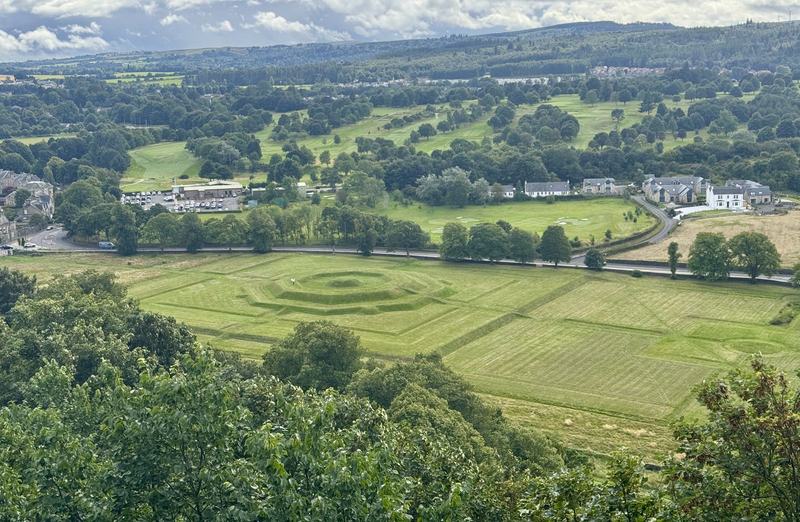
Historians vary in their views about the origins of this mound. Research would be needed to confirm suggestions that it might have been the site of a Roman camp or of a medieval 'motte and bailey' castle.
At the centre of the Knot is a large octagonal-shaped grassy stepped mound, often referred to as the "Cup and Saucer". Some speculate it may have been fashioned on romantic notions associated with King Arthur and the Knights of the Round Table. Barbour, in his account of the Battle of Bannockburn (1314), mentions the "Round Tabil" at the foot of Stirling Castle. When the defeated Edward II of England fled the battle scene pursued by Sir James Douglas, he rode to Stirling Castle but was denied entry by the Castle governor, Sir Philip de Mowbrey, and advised to go by way of the "Round Tabil" to make his escape.
From at least the early 16th century, royal gardens appear to have existed in the "auld" Park at Stirling, but may have existed there in an earlier period. James IV, James V and James VI all took an active interest in European Renaissance cultural ideas and introduced many changes to their Scottish castles, palaces and parks during this period, some of which were fashioned on French and Italian renaissance styles.
James IV's Court contained many philosophers, doctors, artists, astrologers and musicians. He and his grandson James VI (I of England) were said to have been keen gardeners. Formal knot and parterre gardens became fashionable in royal circles across Europe during the 16th and 17th centuries. Knot gardens used closely clipped evergreen hedges, such as box or lavender, to form the outline of complicated garden designs. Parterres were level areas within the garden containing ornamental flower beds. Royal gardens were designed to provide pleasing surroundings to walk in and an attractive landscape when viewed from the Castle or Palace. They also had practical functions, such as providing "prestigious" and varied food for the Royal table.
The outline of this type of formal royal garden containing an "octagonal stepped mound or knot" can still be seen in Kings Knot today. According to Historic Scotland, this garden was "probably laid out in 1627–8 by William Watt, a skilful and well-experimented gardener", "brought from England to supervise the Royal gardens at Stirling and elsewhere." There are suggestions, however, that the origins of this formal garden in the Kings Knot may date back to the 16th century or earlier. There are references to the formation of a "great garden" at Stirling in royal records of the 1490s and early 1500s.
Gradually this Knot garden fell into disrepair. However, in the 19th century restoration work was carried out, possibly as a result of a complaint made by Queen Victoria while on a visit to Stirling in 1842. This work may have "significantly" altered the appearance of this "once magnificent formal garden."
A fine example of a Knot garden can be seen at Drummond Castle Gardens near Crieff.
Know more about this place, or have a photograph or memory of it to share? Tell us →